newt
building a deterministic rigid-body physics engine from scratch in rust, from a tumbling box to an assisted biped walk
jump to a demo or section
i wanted to recreate MuJoCo from scratch in rust: bodies, contacts, joint trees, actuators, and models loaded from MJCF. zero runtime dependencies. feature parity is the direction, not a finished claim.
drop a box, pull a ball, or turn gravity off. the layers below explain what makes this scene work.
these fifteen TypeScript demos explain the math; they do not run newt or establish MuJoCo parity.
a body and a step
everything downstream is one type. a Body carries mass, an inertia
tensor and its precomputed inverse, a world-frame position, a unit
quaternion orientation, a linear velocity of the COM, and a body-frame
angular velocity:
pub struct Body {
    pub mass: f32,
    pub inertia_body: Mat3,
    pub inertia_body_inverse: Mat3,
    pub position: Vec3,
    pub linear_velocity: Vec3,
    pub orientation: Quat,
    pub angular_velocity_body: Vec3,
    // ...
}
angular velocity stays in body coordinates so the inertia tensor is
constant across the step. inertia_body_inverse is stored so the hot path
never inverts a 3x3 in the loop.
the integrator itself is a small enum on the world:
pub enum Integrator {
    /// MuJoCo-style semi-implicit Euler.
    Euler,
    /// MuJoCo's documented implicit-in-velocity approximation.
    ImplicitFast,
    /// The original four-stage integrator. This is the default.
    #[default]
    Rk4,
}
explicit euler uses the old velocity; Euler (semi-implicit) uses the new
one. Rk4 is four derivative evaluations, then one weighted update, with
quaternion normalization at the end, not between stages. ImplicitFast
folds supported joint damping and actuator velocity terms into the
mass-matrix solve; tendon coupling and force-clamp derivatives stay
explicit.
make the clock boring
the world advances by a fixed dt, not the last frame's duration. a viewer
accumulates step credit, spends it in whole steps, and carries the remainder:
self.step_accumulator += self.speed;
let steps = self.step_accumulator.floor() as usize;
self.step_accumulator -= steps as f32;
for _ in 0..steps {
    self.world.step();
    // ...
}
fixed steps are necessary, but ordering and arithmetic matter too. newt uses stable contact order, index tie breaks, and its own scalar routines: sin/cos range reduction and polynomials, plus tan, asin, and atan2. golden trajectories serialize state at fixed steps. repeatability is separate from matching another engine.
repeatable does not mean predictable
identical pendulum inputs produce identical trace bytes. perturb one
starting angle by 1e-6 radians to expose their sensitivity.
the log plot shows actual angle differences, not a fitted line. this JavaScript calculation does not prove newt's cross-platform scalar policy.
contact starts as a spring
my first contacts used a penalty force: stiffness times penetration, minus damping times normal velocity, clamped at zero. a separating contact cannot pull. applying that force away from the center also creates torque. the narrow-phase output is one flat record per contact:
pub struct Contact {
    pub geom_a: usize,
    pub geom_b: usize,
    pub position_world: Vec3,
    /// Unit normal in world coordinates, pointing FROM B into A.
    pub normal_world: Vec3,
    pub penetration: f32,
    pub friction: f32,
    pub gap: f32,
}
normal_world fixes the sign convention, penetration is already shifted
by the pair margin so the solver skips a contact while penetration <= gap,
and friction is the pair Coulomb coefficient. per-pair solref/solimp
live off the geom pair, not on the contact.
newt's penalty path remains the legacy default. before building stacks, i checked static compression, bounce energy loss, and equal-and-opposite collision forces.
from bodies to joint coordinates
robots need connected bodies. a JointKind names what motion each joint
permits:
pub enum JointKind {
    Free,
    Fixed,
    Hinge { axis: Vec3, range: Option<(f32, f32)>, damping: f32, armature: f32, limit: JointLimit },
    Slide { axis: Vec3, range: Option<(f32, f32)>, damping: f32, armature: f32, limit: JointLimit },
    Ball  { damping: f32, armature: f32 },
}
a hinge stores one axis and one q; a ball stores four q (a quaternion)
and three qdot (a body-frame angular velocity). position and velocity
arrays have different lengths on purpose. armature is the reflected rotor
inertia that ABA adds to Sᵀ IA S.
the containing Tree stitches links together and stores those coordinates
as one flat vector each:
pub struct Tree {
    pub links: Vec<Link>,
    pub q_offset: Vec<usize>,
    pub v_offset: Vec<usize>,
    pub q: Vec<f32>,       // generalized position, follows JointKind::nq
    pub qdot: Vec<f32>,    // generalized velocity, follows JointKind::nv
    pub qfrc_applied: Vec<f32>,
    pub actuators: Vec<Actuator>,
    pub applied_wrenches: Vec<(Vec3, Vec3)>,
    pub tendons: Vec<Tendon>,
    // ...
}
the demo solves two coupled point-mass equations with RK4. newt uses
Featherstone's ABA over this Tree: an outward velocity pass, an inward
articulated-inertia pass, then outward acceleration recovery. CRB mass
matrices and RNE inverse dynamics reuse the same layout for independent
round-trip checks.
the browser round trip checks coupled equations against cartesian forces and moments: apply torque, calculate acceleration, then recover the torque.
this instantaneous dynamics check does not measure integrator error. newt's
documented round-trip tolerance is 5e-4; browser arithmetic is f64.
finding what touches
broad phase chooses pairs; narrow phase finds contact geometry. every geom has an AABB, and the default broadphase is a dynamic AABB tree with fat bounds:
pub struct Aabb {
    pub min: Vec3,
    pub max: Vec3,
}

pub enum BroadPhaseMode {
    #[default]
    DynamicAabbTree,
    /// Quadratic fallback kept for comparison and diagnostics.
    Naive,
}
this sweep is a browser comparison, not a claim about newt's broad phase. newt's documented baseline enumerates stable, filtered geometry pairs. narrow phase uses primitive routines, box separating-axis tests, and GJK/EPA for convex queries. face contacts need manifold recovery too. support remains pair-specific: several heightfield pairs are rejected, and box-mesh remains deferred after a measured normal mismatch.
soft constraints and friction cones
v1 added soft constraints. a Jacobian maps joint velocity into contact
motion; solref sets reference response and solimp sets impedance.
regularization allows finite compliance, so a small overlap under load can
be intentional. the impedance profile is the five-parameter sigmoid:
pub struct SolImp {
    pub dmin: f32,
    pub dmax: f32,
    pub width: f32,
    pub midpoint: f32,
    pub power: u32,
}
d(r) interpolates from dmin at zero violation to dmax at width; the
fraction d is projected in the cone, the remainder 1 - d becomes
regularization on A's diagonal. friction bounds tangential force by μN;
the cone shape is a separate enum:
pub enum ConeKind {
    Pyramidal,
    Elliptic,
}
sliding starts when tan(θ) exceeds μ. this cross-section assumes equal
static and kinetic friction and no rotation. newt's PGS supports both
cones; their different boundaries change the force projection.
one correction changes the next
the world-level solver configuration picks between penalty, PGS, and Newton, and fixes the iteration count so runs stay bit-repeatable:
pub struct SolverConfig {
    pub mode: SolverMode,   // Penalty | Pgs | Newton
    pub iterations: u32,
    pub cone: ConeKind,
}
this demo projects positions, not newt's regularized force-space PGS rows.
the playground and wall share its mass-weighted correction, extended to 2d
contacts with rotation, friction, and restitution impulses. Newton runs a
dense Hessian with line search and rejects elliptic cones; CG is not
counted as implemented.
warm start applies the prior frame's impulses before the first sweep. cold start rebuilds support forces from zero.
this velocity-space comparison illustrates a solver technique; it does not claim that newt implements caching.
put the pieces under load
the projectile has eight times each box's mass. aim low to remove support or high to peel boxes off the wall.
the scene uses fixed steps, clipped box contacts, and sequential impulses. position correction repairs overlap without adding velocity. it is a small rigid-body model, not newt's soft-contact solver. newt still has a documented RK4 difference: PGS/Newton forces stay fixed through stages, while MuJoCo reevaluates them.
make an actuator do work
newt grew from clamped position servos into a pipeline: control, activation, gain, bias, transmission, and force limits. the transmission model is a variant per flavor:
pub enum ActuatorFlavor {
    Position { kp: f32, kv: f32 },
    Velocity { kv: f32 },
    Motor    { gear: f32 },
    General  { gain_type: GainType, gain_prm: [f32; 3],
               bias_type: BiasType, bias_prm: [f32; 3], gear: f32 },
    Muscle   { gain_prm: [f32; 9], bias_prm: [f32; 9],
               length_range: [f32; 2], acc0: f32, gear: f32 },
}
each attached Actuator binds one flavor to a hinge/slide link_idx or
to a tendon_target, and carries an activation state:
pub struct Actuator {
    pub link_idx: usize,
    pub tendon_target: Option<usize>,
    pub flavor: ActuatorFlavor,
    pub dyn_type: DynType,        // None | Filter | Muscle
    // ...
    pub ctrl_range: Option<(f32, f32)>,
    pub force_range: Option<(f32, f32)>,
    // ...
    pub ctrl: f32,
    pub act: f32,
}
muscles add length and velocity curves. the same act cannot produce the
same force at every length or shortening speed.
this demo uses newt's documented active curve shapes with a simple straight
tendon and damped two-link dynamics; it omits passive muscle force. newt
also supports fixed and spatial tendons, wrapping, and length Jacobians.
its muscle loader requires a length_range instead of discovering one
automatically.
wrapping adds two tangent points and an arc around the peg. tendon length stays continuous when the straight path clears it. wrap objects sit between adjacent sites:
pub enum SpatialWrap {
    Sphere(WrapSphere),
    Cylinder(WrapCylinder),
}
newt extends this construction to sphere and cylinder wraps. length derivatives turn tendon tension into joint torque, so a routing error becomes a force error.
a model you can inspect
JSON came first, then a hand-written XML parser for an MJCF subset. the
loader assembles a Scene: a runtime World plus name tables that resolve
back to indices:
pub struct Scene {
    pub world: World,
    pub bodies_by_name: HashMap<String, usize>,
    pub trees_by_name: HashMap<String, usize>,
    pub links_by_name: Vec<HashMap<String, usize>>,
    pub geoms_by_name: HashMap<String, usize>,
    // ...
    pub sites_by_name: HashMap<String, usize>,
    pub actuators_by_name: HashMap<String, (usize, usize)>,
    pub sensors_by_name: HashMap<String, usize>,
    pub tendons_by_name: HashMap<String, (usize, usize)>,
    // ...
}
paired fixtures must produce byte-identical newt trajectories. unsupported fields must fail: silently ignoring a damping setting means silently loading a different physical model.
sensors and queries made controllers possible. one enum spans every reading newt exports; each variant is a validated index tuple:
pub enum SensorKind {
    JointPos { tree: usize, link: usize },
    JointVel { tree: usize, link: usize },
    Gyro(SiteFrame),
    Accelerometer(SiteFrame),
    Touch { geom: usize },
    Force { tree: usize, link: usize },
    Torque { tree: usize, link: usize },
    Rangefinder(SiteFrame),
    // ...
}
frames matter: an accelerometer reports specific force, reading zero in free fall and support against gravity at rest. joint readings, gyros, touch, force, torque, rangefinders, keyframes, and point Jacobians each need explicit semantics.
the biped was the integration test
the walker combined a free pelvis, ten hinges, foot contacts, actuators,
and a gait controller at dt = 0.005 s. the recorded assisted 5000-step
run covered about 2.52 meters at 117.60 bpm, with roughly 0.20 meters of
foot clearance. these are documented engine results, not browser
measurements.
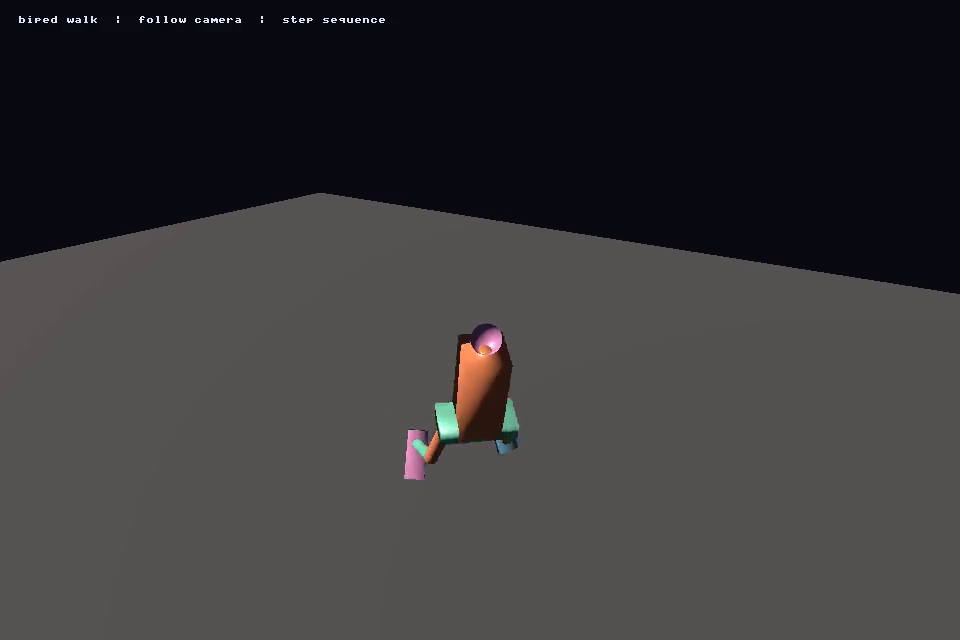
assistance matters: assist_scale=0.8 applies a balance wrench at the
root. in the matched v3 oracle, both engines walk at 0.8 and fall at lower
levels. the 0.4 run still has a 205-step fall-time gap. the milestone was a
robot whose differences i could measure, not unassisted walking.
evidence before speed
analytic anchors check known answers. goldens check repeatability. differential tests compare against offline MuJoCo captures with matched models, state, steps, and controls. those comparisons need tolerances: newt state is f32, captured MuJoCo state is f64. a measured residual belongs beside its bound; raising a tolerance does not explain a mismatch.
performance work then removed repeated allocation in ABA, tendon, and Newton workspace while preserving fixtures. timings vary by scene and machine; there is no general real-time guarantee. the useful result is being able to replay inputs and explain why the motion changed.